Klaus Honnef (1939–2026): a pioneer of photography as art
Personal memories
By Claude W. Sui
With his passing, the German art and photography scene has lost one of its most influential figures. As an art historian, curator and critic, he shaped the discourse on photography as an independent form of artistic expression for decades.
Although he was not a direct member of the DFA, Klaus Honnef was closely associated with the association and its photographic community. Through his written work on photographers such as Helmut Gernsheim and Robert Häusser — who were both members of the DFA — he also had a direct link to the association's history. However, his influence extended far beyond this. Through his theoretical and curatorial commitment to the artistic autonomy of photography, he made a significant contribution to redefining the understanding and recognition of the medium. Therefore, his impact cannot be measured by institutional membership alone.
Documenta 6 in 1977 marked a decisive turning point in the history of German photography. Under the curatorial direction of Honnef, Evelyn Weiss and his wife, Gabriele Honnef-Harling, photography — in all its historical and contemporary complexity — was placed within a new aesthetic and art-historical context. Honnef engaged intensively with questions of authorship and artistic signature. In addition to his numerous exhibitions and publications, he was a dedicated university lecturer and a critical, combative spirit whose voice we shall miss.
My first encounter with his work was the 1982 exhibition Lichtbildnisse – Das Porträt in der Fotografie at the Rheinisches Landesmuseum in Bonn. I was deeply impressed. The catalogue, which was carefully researched and expertly written, became a constant companion during my art studies.
We met in the 1980s at a Robert Häusser exhibition in northern Germany, which was opened by Honnef. He later wrote a significant essay for the publication Robert Häusser: From the Photographic Work 1938–2000.
I have a particularly fond memory of the SACHLICH NEU exhibition. Photographs by August Sander, Albert Renger-Patzsch and Robert Häusser, which took place in 2024. Klaus Honnef accepted my invitation and contributed an essay to the exhibition catalogue, in which he examined the portraits by Sander and Häusser, offering unusual perspectives. He subsequently posted a remarkably personal tribute to accompany the exhibition on Facebook. Not only did he emphasise the comparison of the three photographic approaches, he also emphasised the aim of viewing photography beyond fashionable or superficial attributions. His explicit mention of me as the curator was a special gesture of appreciation. Above all, however, this demonstrated what I valued so much in Klaus Honnef: his independence of judgement, his intellectual curiosity, and his genuine engagement with the exhibition and its themes.
For my 2012 exhibition, 'The Birth of Photography – Highlights from the Gernsheim Collection', which featured an exclusive presentation of Niépce's heliograph in Mannheim for the first time, I invited Klaus Honnef to be the keynote speaker at the opening. He was able to contextualise the experiences of emigrants such as Helmut Gernsheim within a broader historical and human framework. In his essay And They Had to Leave Germany… – Photographers and Their Images 1928–1997 (Kunst Kurier, 1997), he delves into the life stories of German photographers in exile, including Gernsheim’s journey from Paris to London in 1937. His speech in Mannheim was moving, insightful, and imbued with great empathy.
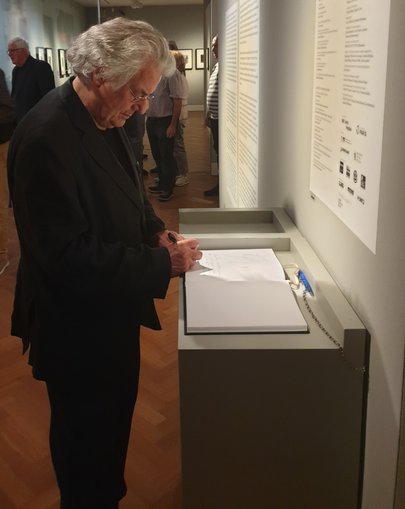
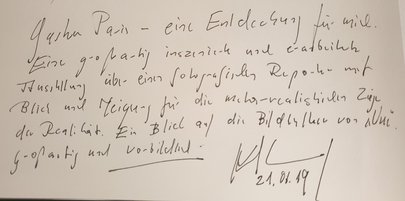
Another lovely encounter occurred during our 2019 exhibition, 'Gaston Paris – The Insatiable Camera', which I curated with the Centre Pompidou, Florian Ebner and Michel Frizot. Klaus Honnef arranged a visit for a group of photography enthusiasts, and I was able to give them a guided tour. His comments and questions enriched our time together. It was a discovery for him at the same time, as he had not previously been familiar with this unjustly forgotten photographer. In the visitors' book, he left a very positive review of the exhibition. This recognition from such a distinguished connoisseur of photography meant a great deal to me and filled me with pride.
His comments on Facebook were another unique form of interaction. They would be well worth compiling and publishing. Here, the man behind the essays and art-historical texts emerged: nuanced, humorous, and far from a black-and-white thinker. Over time, his more personal side also emerged. Despite his health limitations, he continued to engage in discussion and his thoughts and observations inspired a vibrant online community. Many took a keen interest in his daily life and declining health.
Dear Klaus Honnef, we shall miss your wise and illuminating comments, your linguistic precision, and your special ability to shed light on things from a different perspective.